Bo Kristensen
Backlog Refinement in 2026
Backlog refinement in 2026 is not about making tasks “ready.” It’s about building shared understanding. When teams are aligned on why, what, how, and size, they can take ownership of the work and move forward with confidence.
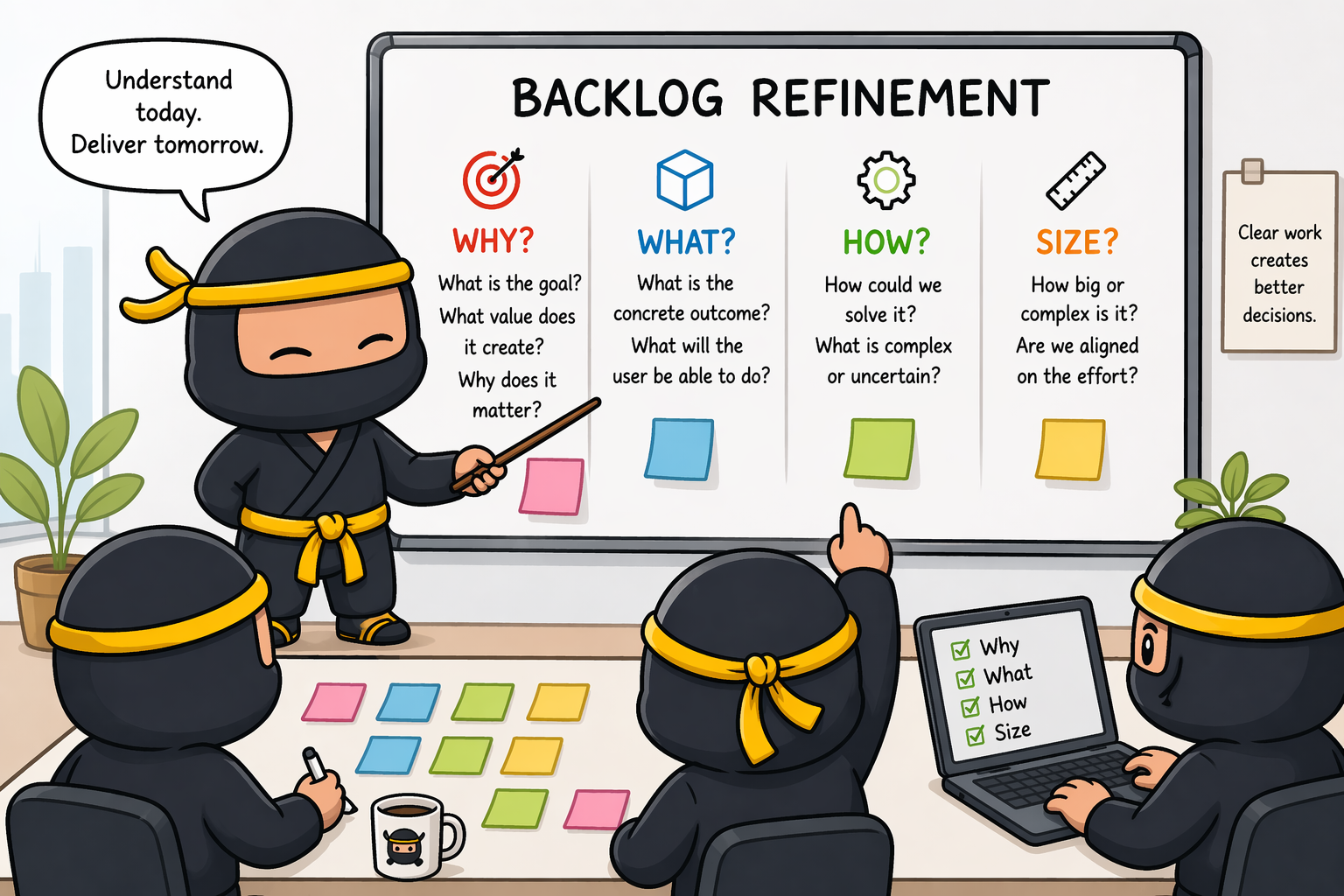
Backlog refinement is still a central part of how teams work with product development in 2026.
Not as a fixed ceremony.
Not as a checklist.
But as a way to ensure that the team understands the work before getting started.
What is backlog refinement?
Backlog refinement is the process where a team works on upcoming tasks to prepare them for development.
It’s not just about describing the work.
It’s about building shared understanding.
This typically happens through:
- team discussions
- questions and clarifications
- breaking down larger tasks
- assessing complexity
The purpose of refinement
The purpose is simple:
To ensure that the team knows enough about a task to take ownership of solving it.
When refinement works well, it means:
- everyone understands why the task exists
- there is a shared understanding of what needs to be built
- the team has an idea of how it can be solved
- the complexity is reasonably aligned
The four core elements
In 2026, backlog refinement can be boiled down to four questions:
1. Why — why are we doing this?
What is the purpose of the task?
What value does it create?
2. What — what are we building?
What is the concrete outcome?
What is different once the task is completed?
3. How — how could it be solved?
What approaches make sense?
Where does the complexity lie?
4. Size — how big is it?
How large or complex does the task feel?
Do we have a shared understanding of the effort?
Breaking down work
A key part of refinement is breaking larger tasks into smaller pieces.
This makes the work:
- easier to understand
- easier to estimate
- faster to deliver
At the same time, it helps uncover uncertainties early.
When is something ready?
A piece of work is ready when the team:
- understands the purpose
- agrees on what needs to be built
- has a realistic idea of how
- shares an understanding of the size
This doesn’t mean everything is fully detailed.
But it means there is enough clarity to get started with confidence.
Refinement in practice
In many teams, refinement still happens in meetings.
But in 2026, it is often:
- an ongoing activity
- driven by dialogue rather than documentation
- something the whole team participates in
It’s not a single moment.
It’s a continuous process.
In short
Backlog refinement is not about making tasks perfect.
It’s about making them understandable.
And it remains one of the most important foundations for teams to deliver value effectively.